Here’s what 20 years in audio engineering taught me about buying a subwoofer: most people overthink the specs and underthink the setup. A well-chosen, properly set up $250 sub beats a carelessly set up $800 one every time. This guide covers both what to buy and how to get the most from it.
Four Questions That Narrow It Down Fast
- What’s your room size? Under 200 sq ft: 8-10 inch. Typical living room (200-400 sq ft): 12 inch. Large room or dedicated theater: 12-15 inch, or two subs.
- Movies or music? Movies: ported for impact. Music: sealed for accuracy. Both: lean sealed — more versatile.
- What’s your budget? Under $200: BIC F12. $200-300: Klipsch R-120SW. $400-600: SVS SB-1000 Pro. $600+: SVS PB-2000 Pro or REL.
- Apartment or house? Apartment: sealed sub, isolation pad, moderate volume. House: more flexibility on all fronts.
The Specs to Actually Pay Attention To
RMS Watts (Not Peak)
Every sub has a peak watt rating and an RMS (continuous) rating. Only the RMS number matters. “3000W peak, 75W RMS” is a mediocre sub. “300W RMS” is a good one. Peak watts are marketing. Don’t let them mislead you.
Frequency Response at -3dB
A spec of “20Hz-200Hz” is useless without knowing at what output level the sub reaches 20Hz. The -3dB point tells you: a sub rated “40Hz -3dB” starts rolling off significantly at 40Hz. A sub rated “20Hz -3dB” actually produces useful output at 20Hz. Look for the -3dB number, not just the frequency range.
Driver Size
Larger means more potential output. But quality of design matters more than size — a well-designed 10-inch can outperform a cheap 15-inch. Don’t overbuy driver size for a small room.
Best Picks by Budget
| Budget | Pick | Why |
|---|---|---|
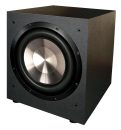
| Check Amazon | BIC America F12 | Best value in audio — full stop |
| Check Amazon | Klipsch R-120SW | Best for home theater at the price |
| Check Amazon | SVS SB-1000 Pro | Reference for music and all-round use |
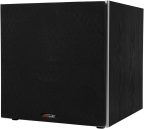
| Check Amazon | Polk PSW10 | Safe entry-level pick for small rooms |
Sealed vs Ported: Pick This First
Before comparing any specific models, decide which enclosure type you need:
- Sealed: Accurate, musical, tight. Better for music and smaller rooms. SVS SB series, Dayton Audio sealed models.
- Ported: More output, deeper extension, more impactful. Better for home theater. Klipsch R series, BIC F series.
5 Things to Do After You Buy
- Use the subwoofer crawl to find the best room position
- Set main speakers to “Small” in your receiver
- Start crossover at 80Hz and adjust from there
- Run Audyssey or YPAO if your receiver has it
- Set the phase switch — test both 0° and 180°, pick whichever sounds fuller
The Biggest Buying Mistakes to Avoid
- Buying based on peak watts — useless number, always check RMS
- Buying too large a sub for a small room — boomy and hard to control
- Not setting up properly — a badly set up sub sounds worse than none
- Maxing out the gain — blend it in, don’t announce it
- Buying from an unknown brand with inflated specs — stick to established names