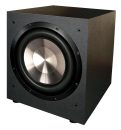
Not every amplifier or receiver has a dedicated subwoofer output. Older stereo receivers, integrated amps, and simpler AV receivers sometimes only have speaker terminals. You can still add a powered sub — here’s how.
Option 1: High-Level (Speaker Wire) Inputs — Easiest
Most powered subwoofers include high-level inputs that accept standard speaker wire. You run speaker wire from your amplifier’s left and right speaker terminals to the sub’s high-level input terminals, in parallel with your main speakers. Both your main speakers and the sub receive the same signal.
How to do it:
- Run speaker wire from your amp’s Left+ and Left- speaker terminals to the sub’s high-level Left+ and Left-
- Do the same for the right channel
- Your main speakers remain connected at the same amp terminals in parallel
- Set the sub’s built-in crossover to 80-100Hz — this filters out the high frequencies so the driver only produces bass
This is actually REL’s preferred connection method for their subwoofers, and they argue it produces more natural integration because the sub senses the same signal as your speakers, including the amplifier’s character. In my experience, it works very well.
Option 2: Preamp/Tape Output
If your amplifier has a preamp output (sometimes labeled “pre-out,” “tape out,” or “rec out”): run an RCA cable from this to the sub’s line-level input. The sub receives a line-level signal and its own crossover handles the frequency filtering.
Option 3: Speaker-Level to Line-Level Converter
A speaker-level to line-level converter (LOC) takes the amplified speaker signal and converts it to a low-level RCA signal. Common in car audio and available cheaply for home use (-15). Connect to your amp’s speaker outputs, then run RCA from the converter to the sub’s line input.
Which Option to Use
High-level input is the cleanest and most common solution for receivers without sub outputs — most quality powered subs include them. Use preamp output if available. Use a converter only if neither of the first two options is available.
Setting Up After Connection
Whichever connection method you use:
- Set the sub’s built-in crossover to 80-100Hz
- Start the gain at 9 o’clock (25% up from minimum)
- Your main speakers play full-range — there’s no bass management in a stereo amp without sub output, so both the speakers and sub will produce bass below the crossover point, which creates some overlap. This is acceptable — reduce the sub’s crossover to minimize overlap if the bass sounds boomy.
- Set the phase — switch between 0° and 180° and choose whichever sounds fuller
The Limitation
Without receiver bass management, your main speakers play full-range (including bass) while the sub also plays bass. This creates some frequency overlap that can sound slightly muddier than a properly crossed-over system. It’s not a problem for most casual listening, but for critical listening you may want to consider a receiver with bass management as a longer-term upgrade.